


RELIGION/BELIEF
WHAT TAKES PLACE IN A CHRISTIAN SCIENCE READING ROOM?
Christian Science Reading Rooms can be found in nearly every major American city and many small towns, often blending in with surrounding storefronts. While they may go unnoticed by passersby, those who pause to look inside might find their purpose puzzling—shelves filled with books, chairs, tables, and an assortment of pamphlets and reading materials. It resembles a waiting room, but without a doctor.
Are they churches? Do they have any connection to Scientology?
Christian Science Reading Rooms are not churches, though they are operated by one, and they have no affiliation with Scientology. They serve as a ministry of the Church of Christ, Scientist, an American religious movement founded in 1879 in Boston by Mary Baker Eddy.
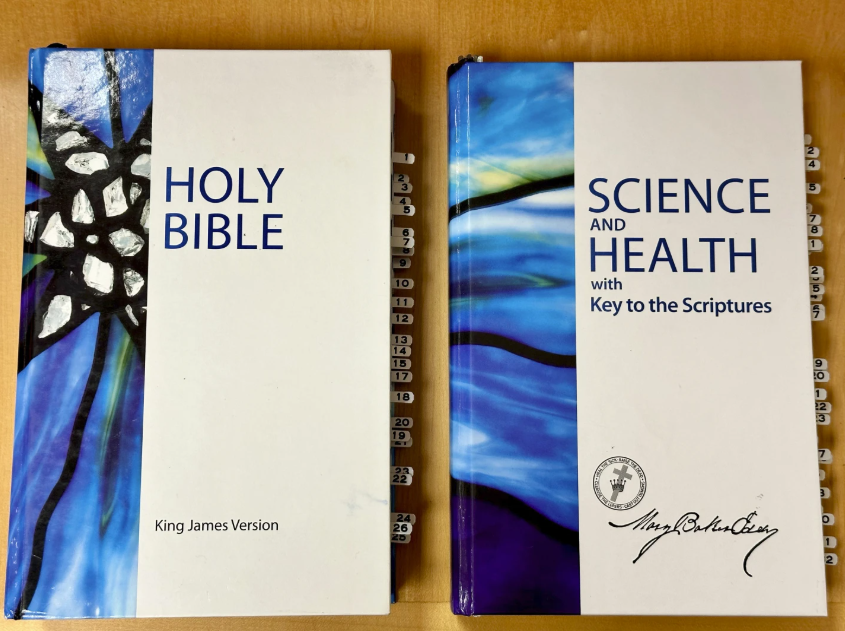
Unlike other Christian denominations, Christian Scientists do not have a traditional human pastor. Instead, their spiritual guidance comes from two books: the Bible and Science and Health with Key to the Scriptures, written by Eddy. This text serves as the church’s foundational work, offering interpretations of the Bible and Christian Science theology, which emphasizes healing through prayer and spirituality. “The reading room functions like a parsonage,” explained Jasmine Holzworth, librarian of the Christian Science Reading Room at the First Church of Christ, Scientist, in Boston—also known as the Mother Church, the denomination’s original congregation. “Instead of a personal pastor, we have the books. People are welcome to come in, sit, and read. These books serve as a trusted pastor, offering guidance and a place for visitors to seek answers to their questions.” Running a reading room, which also sells Christian Science literature, is not optional for a Christian Science church. While some smaller congregations may share one with another local church or operate it for only a few hours each week, every church is required to maintain a reading room, as outlined by Mary Baker Eddy in her Manual of the Mother Church.
On the other hand, reading rooms are always affiliated with a church. Though they may not always be located next to the church itself, they are maintained by one—often in a separate storefront. Christian Scientists view this as beneficial, according to Jasmine Holzworth.
“Not everyone is comfortable walking into a church building—there’s a lot of hesitancy about religion today,” Holzworth explained.
Christian Science Sunday services differ from traditional Christian worship; they do not include a sermon. Instead, they consist of readings from the Bible and Science and Health with Key to the Scriptures, each tied to a specific topic assigned by Eddy for each week of the year. These 26 subjects, which repeat twice annually, cover themes such as “love” and “sacrament” as well as more complex topics like “ancient and modern necromancy, alias mesmerism and hypnotism, denounced” and “Is the universe, including man, evolved by atomic force?”
“Science and Health is a book that constantly directs us back to the Bible,” said Alex Griffin, Deputy Committee on Publication for the state of Massachusetts.
Mary Baker Eddy, who passed away in 1910, was concerned that those interested in Christian Science might struggle to find accurate or authorized literature about the faith in regular bookstores. This concern, according to Holzworth, contributed to the emphasis on reading rooms. During Eddy’s lifetime, figures like New Thought leader Ursula Newell Gestefeld repurposed Eddy’s writings in a non-Christian context, which she believed could create confusion about Christian Science. Even today, the faith is sometimes mistaken for Scientology, making reading rooms essential spaces where individuals can access church-authorized literature. “You have to have the heart driving it,” Holzworth said. “What fuels it is a congregation’s love for the teachings of Christian Science. When love is the motivation, anything is possible.”
Like many American religious groups, Christian Science churches have faced challenges in recent decades, struggling to maintain older buildings amid declining numbers of practitioners and teachers. There are approximately 1,220 Christian Science churches worldwide, with about half located in the United States. However, the denomination does not track or disclose its membership numbers, in accordance with the Manual of the Mother Church, which states, “According to the Scripture they shall turn away from personality and numbering the people.” Some Christian Science churches have transitioned into their reading rooms after selling their buildings, while others have integrated their reading rooms into the church itself.
In Cambridge, Massachusetts, the local Christian Science church acquired its Harvard Square building during the Great Depression and now generates income by renting out portions of the property. Other churches operate in leased storefronts, similar to commercial businesses. While these churches sell religious books for both children and adults to help offset expenses, church representatives declined to provide further details on how they fund their storefront rentals.
San Francisco International Airport houses a Christian Science reading room, where, according to an SFGATE report, the "exorbitant" rent is partially covered by pledges from 10 area churches. Meanwhile, in Naples, Florida, a reading room lost its storefront to a gelato shop in 2017 after the landlord chose not to renew its lease. The Naples reading room, which had been in operation since the 1960s, was paying $790 per month in an area where rents for a similar space had soared to $3,000. It had previously negotiated the lower rent with a former landlord but lost the location after the building was sold.
While Christian Science reading rooms serve as a means to share their faith, the church does not actively seek to convert visitors.
“It’s a gift to the community. You can come in and ask questions. Everyone’s on their own spiritual path. We’re meant to be welcoming to everyone,” said Holzworth. “You’re not going to find someone trying to sign you up for anything. We’re doing this because we love God, but people don’t need to love God to come in here.”
The Mother Church’s reading room, located near Berklee College of Music in Boston, has welcomed Berklee students of various faiths seeking a quiet place to pray and read their Bibles. Even those with no religious affiliation who simply need a peaceful space are encouraged to visit.
For Christian Scientists, however, reading and studying the week’s Bible lessons is a key aspect of their faith.
“Christian Scientists use reading rooms as a place to study and dig in,” Holzworth explained.
The reading room at the Mother Church also holds weekly gatherings where participants read The Christian Science Monitor and pray for those affected by global events.
“It’s not just a Sunday faith,” Holzworth added. “It’s meant to be applied throughout the entire week—not just to our own lives, but to the world around us.”
Larger reading rooms, like the one operated by the Mother Church, have paid staff, while smaller churches rely on volunteers.
“I figured I was going to be studying the Bible and Christian Science anyway, so I might as well do it in a way that serves the community,” said Teddy Crecelius, a tour guide at the Mother Church who has also been involved with Christian Science branch churches. “It’s not a burden.”
"This represents a significant development in our ongoing coverage of current events."— Editorial Board