


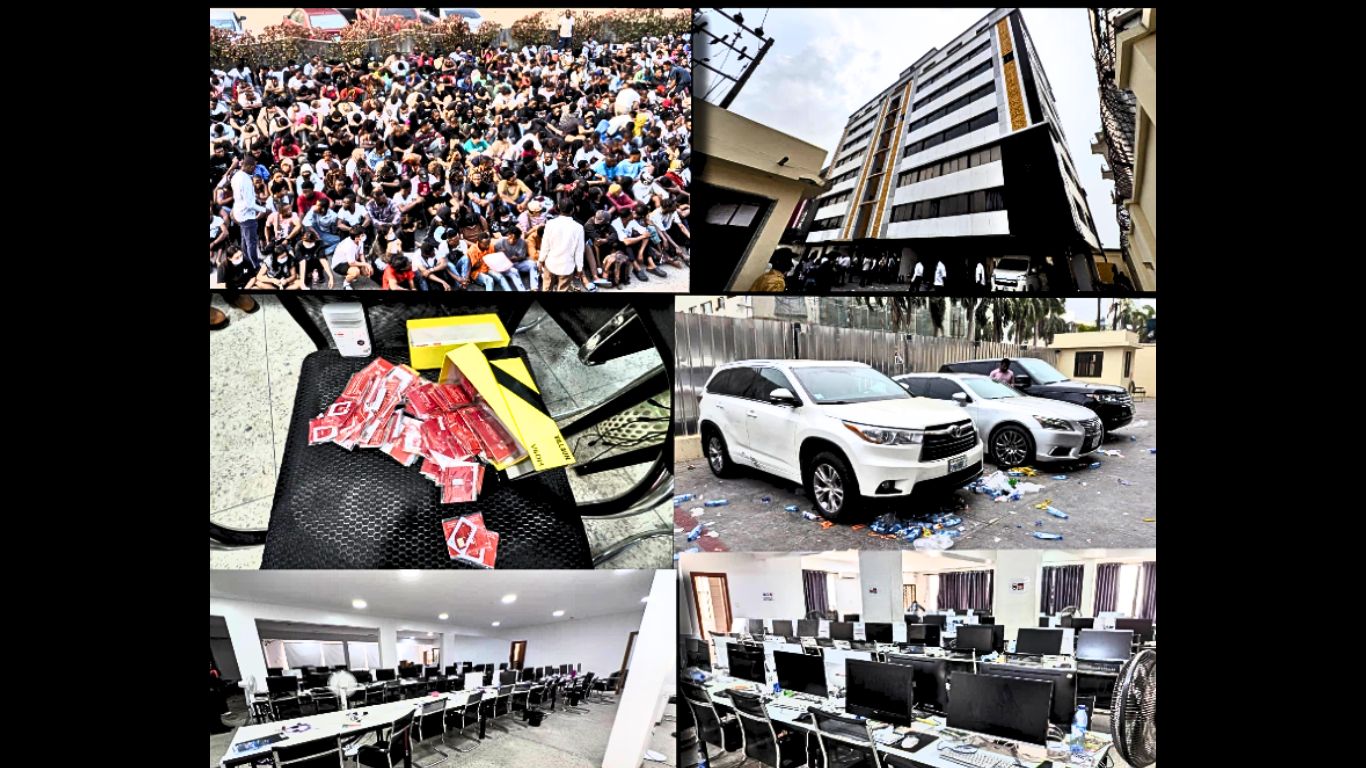
EFCC ARRESTS 792 IN MASSIVE CRYPTO AND ROMANCE SCAM RAID AT LAGOS SKYSCRAPER
In a groundbreaking operation, the Economic and Financial Crimes Commission (EFCC) arrested 792 suspects linked to cryptocurrency investment fraud and romance scams in Lagos. The surprise raid took place on Tuesday, December 10, 2024, at a seven-story building known as Big Leaf Building, located at No. 7 Oyin Jolayemi Street, Victoria Island.
During a media briefing on Monday, December 16, 2024, EFCC Chairman Ola Olukoyede, through the Director of Public Affairs, Commander CE Wilson Uwujaren, disclosed that the arrested suspects included 148 Chinese nationals, 40 Filipinos, two Kharzartans, one Pakistani, and one Indonesian. These foreign operatives allegedly used the high-tech facility to train their Nigerian accomplices in orchestrating scams targeting victims across the globe.
The building, resembling the corporate headquarters of a financial institution, housed all the tools needed for sophisticated cybercrime. On the fifth floor alone, investigators recovered 500 SIM cards purchased for fraudulent purposes. High-end desktop computers equipped every floor, enabling the operatives to prospect for victims online through phishing schemes.
According to the EFCC, the syndicate primarily targeted individuals in the United States, Canada, Mexico, and Europe, with Nigerian accomplices spearheading initial contact via WhatsApp, Instagram, and Telegram. Using fake profiles and foreign phone numbers, the suspects engaged victims in romantic conversations or posed as business investors, ultimately convincing them to invest through a fraudulent online platform, www.yooto.com.
Victims were required to pay an activation fee of $35 to begin using the platform. The Nigerian recruits, selected for their typing skills and computer proficiency, underwent a two-week training program where they were taught to impersonate foreign individuals and manipulate victims into trusting them. Once the victims’ confidence was gained, the foreign masterminds took over, shutting out the Nigerian operatives from the transaction to conceal the fraud's full scope.
Olukoyede revealed that the Nigerian accomplices were not provided with formal employment letters or paid through corporate accounts, making it difficult for them to identify their employers. Payments were made in cash or via personal accounts, further distancing the operation from legitimate practices.
The EFCC Chairman highlighted the need to dispel the perception that Nigerians dominate global fraud networks. “Foreign criminals are exploiting Nigeria’s reputation to establish operations here and mask their criminal enterprises. But as this operation has shown, there will be no hiding place for criminals in Nigeria,” Olukoyede stated.
The EFCC is now working with international partners to determine the full extent of the syndicate’s activities and its connections to global fraud rings. Items recovered from the raid include desktop computers, mobile phones, laptops, and cars.
Michael Wetkas, acting Zonal Director of the Lagos Zonal Directorate, called for stronger collaboration with the media to combat corruption and economic crimes. He emphasized that the suspects would be charged to court upon completing investigations.
The EFCC’s bold operation sends a strong message that the agency remains relentless in its fight against cybercrime and fraud, ensuring that perpetrators face the full weight of the law.
"This represents a significant development in our ongoing coverage of current events."— Editorial Board